A bonsai exhibition can sometimes feel like a gathering of old friends who speak different languages. At first glance, the trees may appear similar: miniature forms in shallow containers, carefully cultivated over many years. Spend a little more time with them, however, and distinct voices begin to emerge. Some trees seem eager to tell a story. Others sit quietly, inviting contemplation. Still others carry the rugged character of landscapes shaped by drought, fire, and survival. These voices belong to the traditions of Chinese penjing, Japanese bonsai, and an increasingly distinctive African approach to bonsai.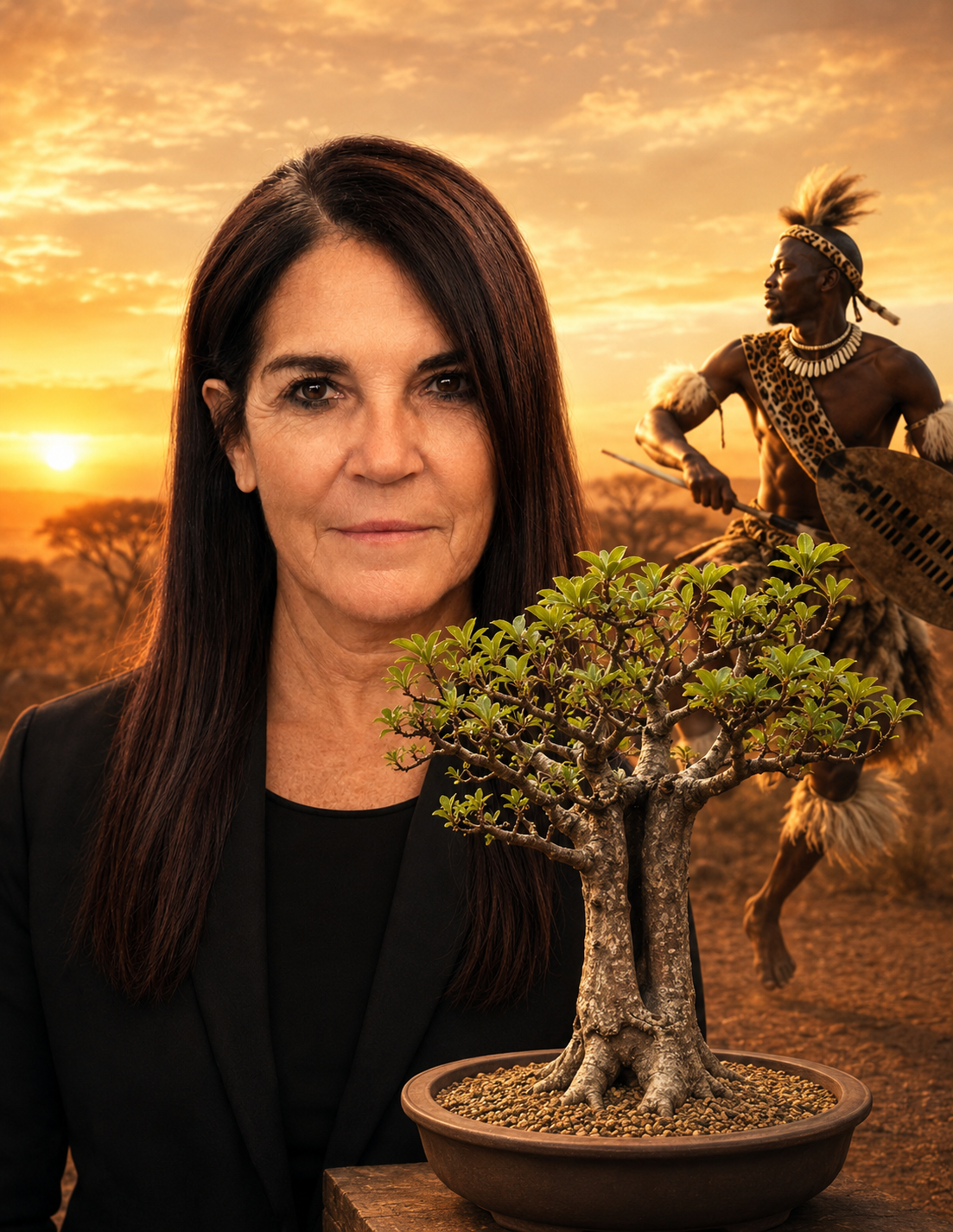
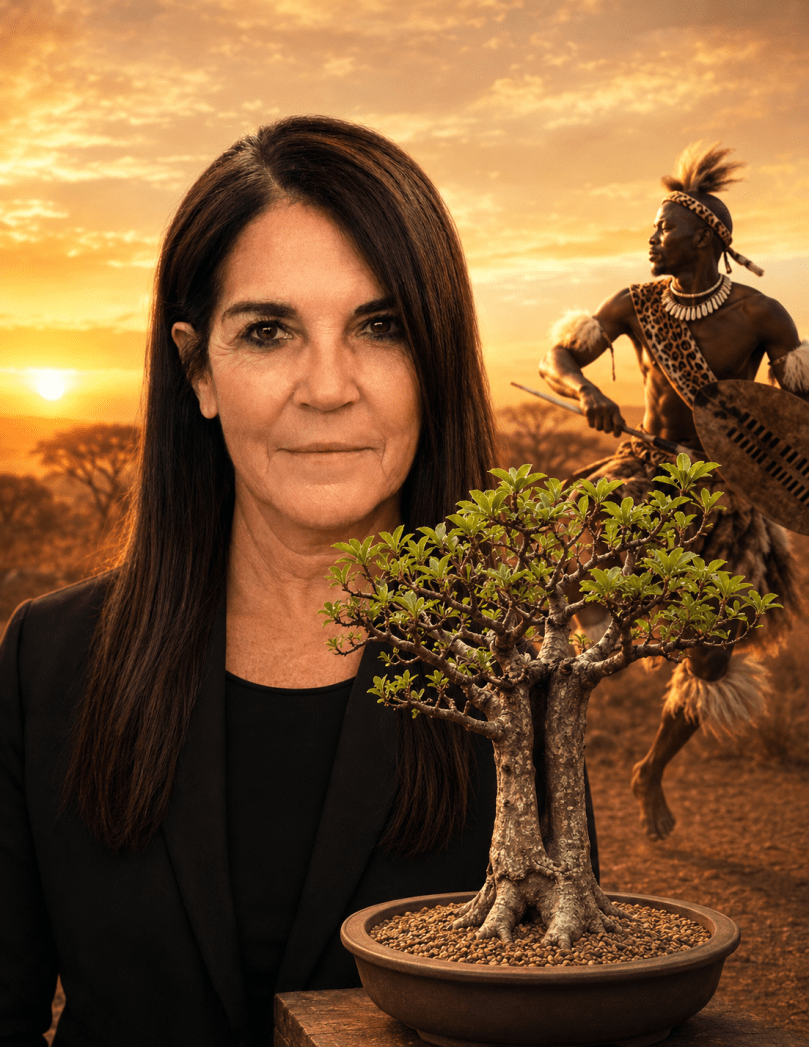
(Created with real images using ChatGPT)
We are very familiar with the history of bonsai and how the earliest origins of miniature tree cultivation can be traced to China, where penjing emerged more than a thousand years ago. The term “penjing” translates roughly as “tray landscape,” immediately signalling a broader artistic ambition than the cultivation of a single miniature tree. Rooted in Daoist philosophy, penjing seeks to capture the vitality, unpredictability, and dynamic movement of nature. Rather than imposing order upon the natural world, the penjing artist works in dialogue with it. Irregularity, asymmetry, and dramatic movement are not merely tolerated but celebrated as expressions of life force or qi. Trees often appear weathered, contorted, and deeply expressive, conveying narratives of survival, struggle, and transformation.
Penjing therefore, becomes narrative in character. This philosophy is visible in the trees themselves. Trunks twist dramatically, branches move with apparent spontaneity, and compositions frequently include rocks, water features, multiple trees, or miniature structures. The goal is not simply to create a beautiful tree. The goal is to create a living landscape that evokes a feeling, a memory, or a story. Looking at a penjing composition can feel like opening the first page of a novel. The viewer is invited to imagine mountains shrouded in mist, windswept cliffs, lonely travellers, or ancient forests. Every element contributes to the narrative.
Japanese bonsai, although historically derived from penjing, evolved into a distinctly different tradition. Influenced by Zen Buddhism, Shinto aesthetics, and a cultural preference for restraint and refinement, bonsai seeks to distil rather than narrate. Where penjing often embraces complexity, bonsai strives for essence. The question asked by the Japanese artist is not “What story does this tree tell?” but rather “What is the purest expression of this tree’s nature?”
When the art travelled to Japan, it evolved into something different. The Japanese did not merely adopt penjing; they refined it according to their own cultural values and aesthetic sensibilities. Influenced by Zen Buddhism and concepts such as wabi-sabi, Japanese bonsai became less concerned with storytelling and more concerned with essence.
Where penjing often expands outward into a landscape, bonsai narrows its focus. The tree becomes the centre of attention. The challenge for the artist is to reveal the essential character of that tree with clarity and restraint. Nothing is unnecessary. Every branch, every angle, every space serves a purpose.
A well-crafted bonsai often appears effortless, although practitioners know how much work lies beneath that illusion. Years of pruning, wiring, repotting, and patient observation are concealed behind a natural appearance. The artist’s hand is present but discreet. Bonsai does not seek to impress through complexity. It succeeds through balance, proportion, and quiet confidence.
Despite these differences, penjing and bonsai share important common ground. Both traditions seek to evoke age, maturity, and the passage of time. Both rely upon principles of proportion, balance, movement, and harmony. Both require extraordinary horticultural skill and a profound understanding of trees. The difference between the two traditions can be felt in the way they engage the viewer. Penjing invites exploration. Bonsai encourages contemplation. One draws you into a story. The other invites you to pause and simply be present.
The African contribution to bonsai introduces another dimension altogether. Africa’s landscapes are unlike those of China or Japan. Trees here grow under conditions that demand resilience. They endure drought, intense sunlight, seasonal fires, grazing animals, and rocky soils. Survival leaves visible marks.
Anyone who has walked through the bushveld, stood beneath a baobab, or admired an ancient wild olive understands that African trees possess a presence that is difficult to ignore. They do not always conform to classical bonsai ideals. They can be abrupt, irregular, scarred, and stubborn. Yet these very qualities make them compelling subjects.
Over the years, African practitioners have increasingly embraced indigenous species and local landscapes as sources of inspiration. Styles such as the Baobab, Bushveld, Flat Top, Wonderboom, Wild Fig, and Pierneef have emerged as recognisable expressions of African bonsai. These styles do more than imitate nature. They celebrate uniquely African forms and ecological realities.
The resulting trees often convey strength rather than elegance. Deadwood is not merely decorative; it reflects the realities of survival. Heavy trunks and weathered bark speak of endurance. Sparse foliage may suggest drought rather than refinement. The emphasis shifts from perfection to authenticity.
What Africa contributes extends beyond aesthetics. Across many African cultures, trees occupy a special place within community life. They provide shelter, mark gathering places, preserve memories, and feature prominently in stories and traditions. A large tree is often more than a biological organism. It is a witness to generations.
This perspective encourages a different relationship between practitioner and tree. The artist becomes less of a sculptor and more of a custodian. Rather than asking, “How can I improve this tree?” one might ask, “How can I honour what this tree has already become?”
That subtle shift changes everything.
Viewed together, penjing, bonsai, and African bonsai offer three complementary ways of seeing the natural world. Penjing celebrates nature’s stories. Bonsai reveals nature’s essence. African bonsai honours nature’s endurance.
None is superior to the others. Each highlights qualities that might otherwise be overlooked. Together, they enrich our understanding of what bonsai can be.
As bonsai continues to evolve across continents and cultures, perhaps its greatest strength lies in this diversity. Different traditions challenge us to look more carefully, think more deeply, and appreciate trees from perspectives beyond our own. The miniature tree in a pot becomes far more than an artistic object. It becomes a meeting place between cultures, philosophies, landscapes, and generations.
Whether we are drawn to the dramatic narratives of penjing, the refined simplicity of bonsai, or the resilient character of African styles, we are ultimately responding to the same thing: the remarkable ability of trees to reflect life itself.
And that is where beauty truly unites us.
(ChatGPT used to language edit)
 bonsaichology